Back To Top
Experience Industrial Innovation Conference & Expo Experience Industrial Innovation Conference & Expo
Step into the future of industry.

Step into the future of industry.

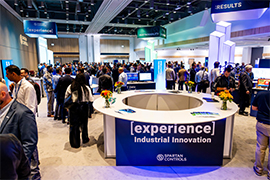
Experience Industrial Innovation 2026 is a two‑day event designed for leaders who want practical insight, proven technologies, and real outcomes. From modern plants to sustainable operations, discover what’s working today, and what’s next.
Register Today

Who Should Attend?

Executive and capital project decision‑makers
Sustainability, energy, and emissions leaders
Digital transformation and OT/IT stakeholders
Engineering and reliability teams

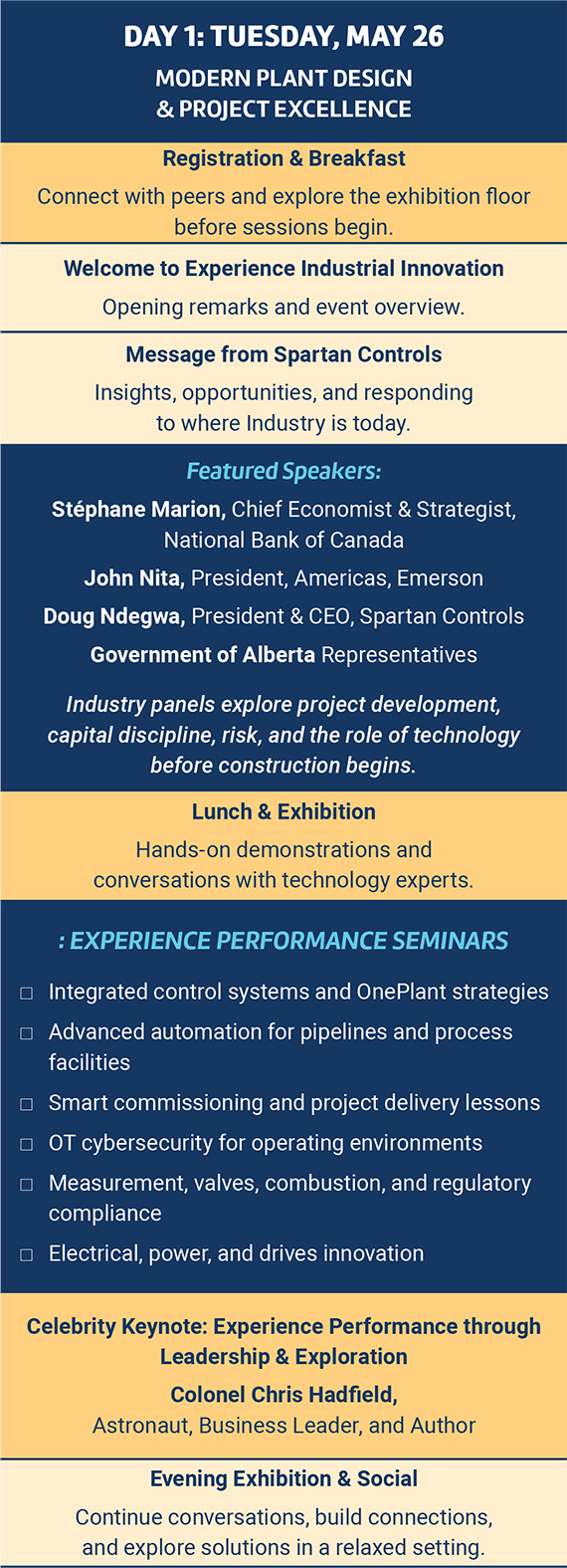
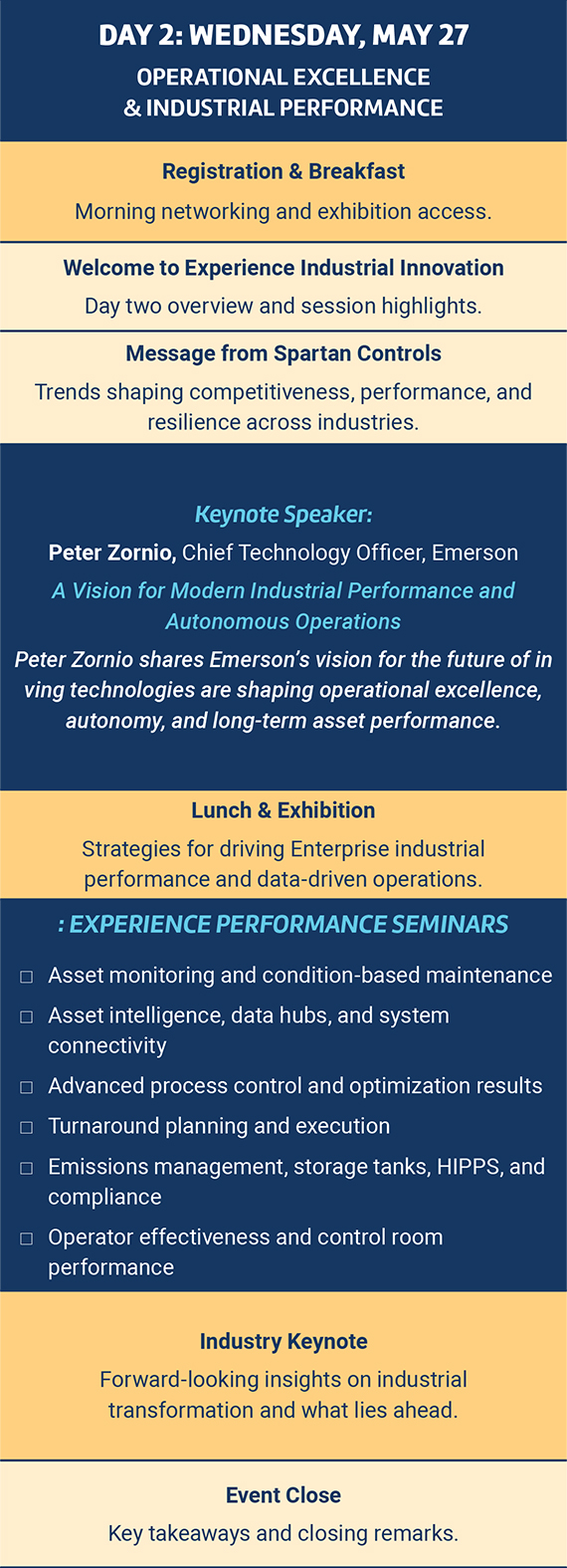
Agenda

What can I expect over the two days?

Strategic perspectives from industry and technology leaders
Practical breakout sessions focused on real operational challenges
Technology showcases and consulting‑led insights
Peer networking across industries and regions

Explore Day 1 Session Abstracts To Find The Sessions Most Relevant To You.

Following an in‑depth technical evaluation, Paramount Resources adopted a fully integrated DeltaV control architecture for its facility, including compressor controls, executed using Spartan’s OnePlant strategy. This approach replaced traditional, islanded PLC compressor packages with a unified DeltaV system across multiple vendors.

By eliminating complex communication interfaces and manual mapping, the project improved plant‑wide visibility, simplified system integration, and reduced long‑term maintenance complexity and cost. This session explores how a standardized control strategy streamlined execution and delivered a more scalable, sustainable control architecture. 
Pembina addressed operational inefficiencies caused by siloed PLC control and limited SCADA automation by implementing a centralized DeltaV system integrated via OPC. This foundation enabled advanced automation capabilities, including model predictive control, machine‑learning‑based soft sensors, and procedural automation. The solution improved crude blending, product switching, pig tracking, and line operations, delivering measurable cost savings while reducing operational risk and operator workload. 
Imperial Oil transitioned from time‑based valve maintenance to a predictive strategy using FIELDVUE digital valve diagnostics and AMS. By focusing maintenance efforts only on valves showing early signs of degradation, the site reduced unnecessary rebuilds, minimized unplanned failures, and improved reliability across multiple HRSG units. 
This session explores the next generation of pressure, temperature, and level measurement technologies designed to deliver best‑in‑class accuracy, stability, and long‑term reliability. Attendees will be introduced to advanced diagnostics, the industry’s first fully integrated wireless non‑contacting radar level solution, and modern wireless architectures that support large‑scale IIoT deployments. 
IPC Blackrod is a 30,000 bpd SAGD facility targeting first oil in Q3 2026. Early in the project, IPC invested in smart instrumentation and digital commissioning using AMS Device Manager and DeltaV. As execution constraints emerged, IPC pragmatically adapted its smart commissioning strategy, retaining high‑value elements that delivered improved data quality, reduced documentation effort, and lower commissioning cost. 
This session presents a practical, risk‑based approach to OT cybersecurity that prioritizes operational safety, reliability, and business continuity. Attendees will learn how to focus cybersecurity efforts where they matter most, without disruption, by taking incremental, defensible steps grounded in how industrial facilities actually operate. 
This session outlines best practices for catalyst maintenance, AFR system troubleshooting, and emissions test preparation to support sustained MSAPR compliance. Attendees will gain practical guidance to avoid testing delays while ensuring reliable engine and emissions system performance.  
This session presents Emerson’s strategic roadmap for Fisher control valves, actuation, and digital technologies. Learn how next‑generation solutions are improving energy efficiency, reducing emissions, lowering total cost of ownership, and enhancing process reliability.
As Wolf Midstream expanded into larger, multi‑phase NGL facilities, PLC‑based control designs no longer met scalability and lifecycle needs. This session explores the migration to a native DeltaV architecture, delivering improved integration, visibility, and long‑term sustainability.  
This session examines the elements that define high‑performance control rooms, including human‑machine interface design, alarm management, layout, and human factors. Drawing on real‑world experience, it highlights why many digital initiatives fail and how to design control rooms that improve decision‑making and operational outcomes. 
This strategic overview outlines how modern combustion control, monitoring, and digital technologies are being applied to improve reliability, emissions compliance, and system performance across new and existing assets. 
Spartan’s PowerVue MCC and switchgear solutions apply modular design, arc‑quenching safety technology, and flexible manufacturing to reduce capital cost and compress project schedules. This session explores low‑ and medium‑voltage PowerVue solutions and their impact on execution certainty and electrical safety.

Explore Day 2 Session Abstracts To Find The Sessions Most Relevant To You.

Following an in‑depth technical evaluation, Paramount Resources adopted a fully integrated DeltaV control architecture for its facility, including compressor controls, executed using Spartan’s OnePlant strategy. This approach replaced traditional, islanded PLC compressor packages with a unified DeltaV system across multiple vendors.

By eliminating complex communication interfaces and manual mapping, the project improved plant‑wide visibility, simplified system integration, and reduced long‑term maintenance complexity and cost. This session explores how a standardized control strategy streamlined execution and delivered a more scalable, sustainable control architecture. 

Pembina addressed operational inefficiencies caused by siloed PLC control and limited SCADA automation by implementing a centralized DeltaV system integrated via OPC. This foundation enabled advanced automation capabilities, including model predictive control, machine‑learning‑based soft sensors, and procedural automation. The solution improved crude blending, product switching, pig tracking, and line operations, delivering measurable cost savings while reducing operational risk and operator workload. 
Imperial Oil transitioned from time‑based valve maintenance to a predictive strategy using FIELDVUE digital valve diagnostics and AMS. By focusing maintenance efforts only on valves showing early signs of degradation, the site reduced unnecessary rebuilds, minimized unplanned failures, and improved reliability across multiple HRSG units. 
This session explores the next generation of pressure, temperature, and level measurement technologies designed to deliver best‑in‑class accuracy, stability, and long‑term reliability. Attendees will be introduced to advanced diagnostics, the industry’s first fully integrated wireless non‑contacting radar level solution, and modern wireless architectures that support large‑scale IIoT deployments. 
IPC Blackrod is a 30,000 bpd SAGD facility targeting first oil in Q3 2026. Early in the project, IPC invested in smart instrumentation and digital commissioning using AMS Device Manager and DeltaV. As execution constraints emerged, IPC pragmatically adapted its smart commissioning strategy, retaining high‑value elements that delivered improved data quality, reduced documentation effort, and lower commissioning cost. 
This session presents a practical, risk‑based approach to OT cybersecurity that prioritizes operational safety, reliability, and business continuity. Attendees will learn how to focus cybersecurity efforts where they matter most, without disruption, by taking incremental, defensible steps grounded in how industrial facilities actually operate. 
This session outlines best practices for catalyst maintenance, AFR system troubleshooting, and emissions test preparation to support sustained MSAPR compliance. Attendees will gain practical guidance to avoid testing delays while ensuring reliable engine and emissions system performance.  
This session presents Emerson’s strategic roadmap for Fisher control valves, actuation, and digital technologies. Learn how next‑generation solutions are improving energy efficiency, reducing emissions, lowering total cost of ownership, and enhancing process reliability.
As Wolf Midstream expanded into larger, multi‑phase NGL facilities, PLC‑based control designs no longer met scalability and lifecycle needs. This session explores the migration to a native DeltaV architecture, delivering improved integration, visibility, and long‑term sustainability.  
This session examines the elements that define high‑performance control rooms, including human‑machine interface design, alarm management, layout, and human factors. Drawing on real‑world experience, it highlights why many digital initiatives fail and how to design control rooms that improve decision‑making and operational outcomes. 
This strategic overview outlines how modern combustion control, monitoring, and digital technologies are being applied to improve reliability, emissions compliance, and system performance across new and existing assets. 
Spartan’s PowerVue MCC and switchgear solutions apply modular design, arc‑quenching safety technology, and flexible manufacturing to reduce capital cost and compress project schedules. This session explores low‑ and medium‑voltage PowerVue solutions and their impact on execution certainty and electrical safety.
Stay Where the Action Is

Stay Where the Action Is

A limited number of rooms have been reserved at a special group rate for attendees of our Experience Industrial Innovation Event. 

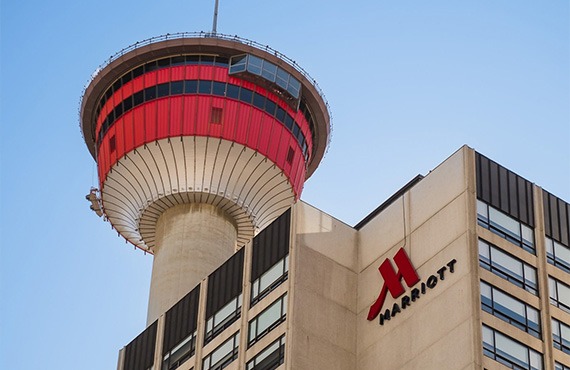
Hotel: Calgary Marriott Downtown Hotel 
Rate: $279 CAD per night 
Dates: Monday, May 25 - Wednesday May 27, 2026

Book now